LEAP 2026 Gains and What Fannie C. Williams Knew
The Louisiana Department of Education has released the 2026 results of Louisiana's statewide standardized test (LEAP), and the headline is one New Orleans has earned: another year of growth. New Orleans was named one of Louisiana's top-growing districts for a fourth straight year. The share of students reaching grade-level Mastery or above climbed from 28% to 31%, outpacing the state. Its 10-point gain since 2022 is the second-largest of any district in the state, double Louisiana's overall improvement. (So yes - we do think we’re so special.)
This is wonderful news that deserves celebration. To the children, families and educators who committed to the daily, sacred work of teaching and learning, and to the paraprofessionals, counselors, cafeteria staff, coaches, and custodians who make every school's win possible: congratulations. The whole city is proud of you.
There's more to celebrate.
Black students in New Orleans grew for the second year running. Schools serving 90%-plus economically disadvantaged populations posted some of the city's strongest gains. The Leah Chase School grew its Black and economically disadvantaged students three to five points across every core subject in a single year. Sophie B. Wright High School moved nine points across more than a thousand test takers. Einstein Charter at Village de l'Est leapt sixteen points overall, the largest single-year gain of any open enrollment school in the city. Frederick A. Douglass High School boasted Algebra I Mastery+ at 65%, a strikingly high mark for an open-enrollment school. Collegiate Academies posted some of the city's largest subgroup gains: Hispanic/Latino students up nearly seven points, students with disabilities up more than four. And Lake Forest Elementary, already one of the highest-performing schools at 81% Mastery, still grew its Black and Hispanic/Latino students by four points. This is movement in the right direction, worth praising loudly.

And. . .
As we celebrate four straight years of top growth in the state, remember: we're celebrating a chapter, not an origin. New Orleans has grown its children before. In other seasons and under other conditions, educators in our city have moved children forward. From top-rated integrated schools in the 1870s, to double-digit increases in Black graduation rates in the 1960s, to increases in English and Math scores in the early 2000s that earned a commendation from the state, to some of the broadest sustained academic gains researchers have ever documented in an American district in the decade after Katrina, it’s always been the people, carrying the same craft, who have ignited the brilliance in our community across every era of educational change.
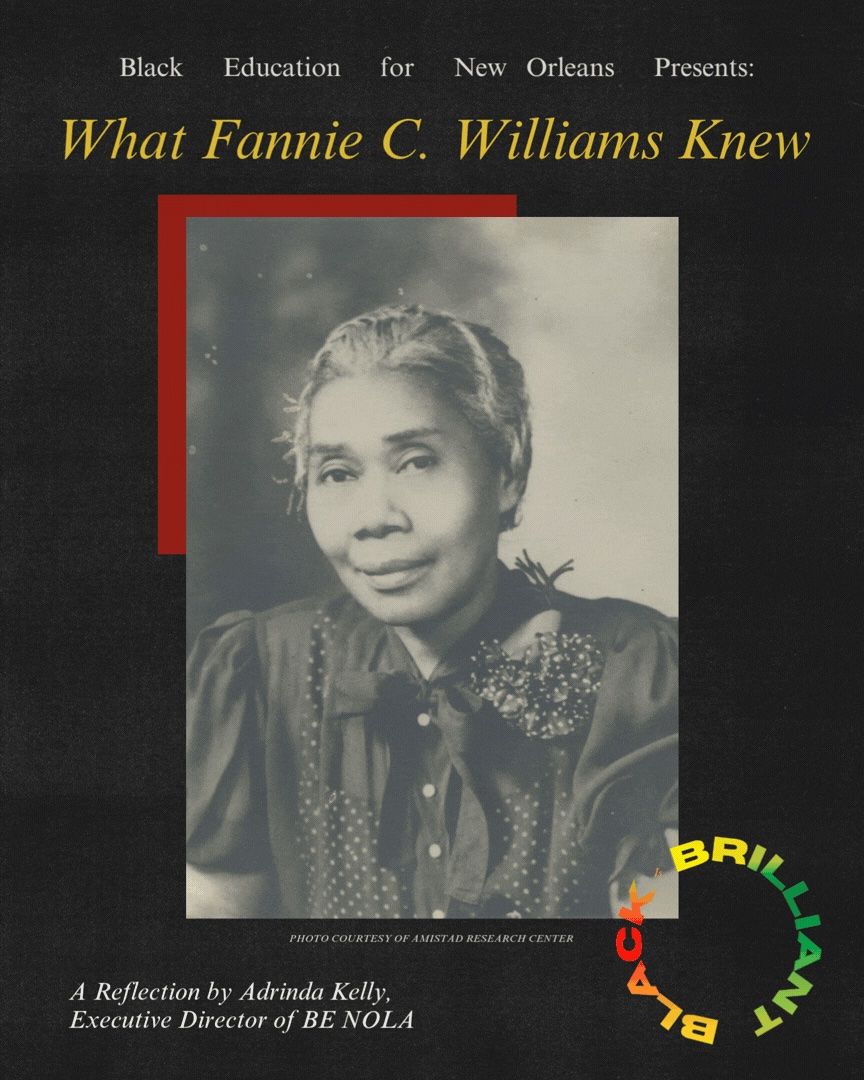
Fannie C. Williams was an embodiment of this craft. From 1921 to 1954, she was principal of Valena C. Jones Elementary, one of the proudest Black institutions in the city during segregation. The school drew Eleanor Roosevelt, Mary McLeod Bethune, W.E.B. Du Bois, George Washington Carver and Jesse Owens through its doors because Williams believed her children should see, in the flesh, the full range of Black brilliance. She built wraparound services decades before the term existed; she started the first kindergarten classes for Black children in the city; she took students on cultural field trips so their world would be bigger than their block. She was defining quality education expansively decades before any of us were born.
She also tested her children. But she embedded testing inside family partnership and whole-child care, and she used it to understand each child's needs, not to rank or sort them. She grasped, three generations ago, the exact distinction we are still fighting to hold onto: that a test can measure something real and necessary and still fail to take the full measure of a child.
Today a school in New Orleans East bears her name. If you read only the test scores in the Mastery column, you might pass right over it. But Fannie C. Williams would not have read only the Mastery column. She would have asked: Are the children fed? Are they seen? Are they exposed to a world worthy of them? Do they feel like they belong here? Do they know whose shoulders they stand on?
Those are BE NOLA’s questions too. They sit behind our Five Pillars of quality education in New Orleans:
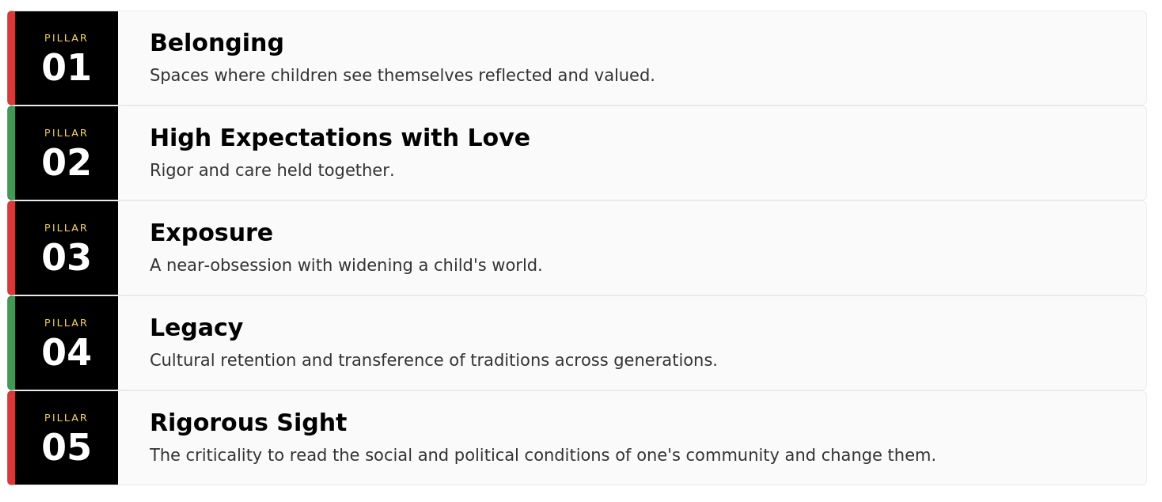
We didn't invent those pillars. We found them, embedded inside Black-led, Black-governed education spaces where children were thriving in ways no official measure counted, in the mold of what researchers find at HBCUs: institutions that take the students everyone else overlooks and grows them holistically. Fannie C. Williams was running all five of those pillars out of a segregated schoolhouse in the 1930s and '40s — belonging, exposure, legacy, and rigor, wrapped around a child who was first fed and seen.
Fannie C. Williams didn't just serve children. She trained a generation of Black educators and stood at the head of their national association. She transmitted the craft. That's the piece Black Education For New Orleans (BE NOLA) holds closely. Through our Black Is Brilliant Institute fellowship, we help educators study and carry this craft forward, wherever they are, in whatever conditions they may find themselves.
Growth like what we see in this year's LEAP scores is rooted in something enduring and true. It is rooted in a craft that belongs to all of us. That's why this November 16-20, we're convening the inaugural New Orleans Black Education History Week, a container for the way-finding and world-making of Black educators, past and present. This history is our shared legacy - a blueprint. It's where a story like Fannie C. Williams's stops being a footnote and becomes a foundation.
The job of a school is to grow children - the whole child. New Orleans is just getting started. Support BE NOLA's Institute and help us bring New Orleans Black Education History Week to life this November.
Donate today: https://blackedunola.
Adrinda Kelly is the Founding Executive Director of Black Education For New Orleans (BE NOLA). Click here to explore our work.